Types of Car Park Barriers in Saudi Arabia and Their Specifications
Car parking barriers are extensively used at commercial sites for traffic control and to create separate spaces for entry and exit. But they are not limited to traffic control, as car park barriers in Saudi Arabia are also used in residential sites for safety purposes and to create temporary parking spaces. Thus, multiple types of car park barriers are available, with each having a distinct structure and specification. You must use the right type of car park barriers to ensure that they align with your application and provide optimal protection or traffic control.
Let’s talk more about the different types of car park barriers in Saudi Arabia, why they are used, and where they are used. It will help you choose the right type of barrier that matches your particular requirements. More importantly, this information will prevent unnecessary expense on the wrong product.
Different Types of Car Park Barriers Used Across Different Sites
The availability of different car park barrier types is critical to get optimal coverage that aligns with your goals. For example, heavy metal barriers are ideal for permanent fencing around the car park, but they are not ideal for creating temporary driveways, as it is difficult to move them. Thus, matching parking barriers with the applications ensures efficiency and optimal protection.
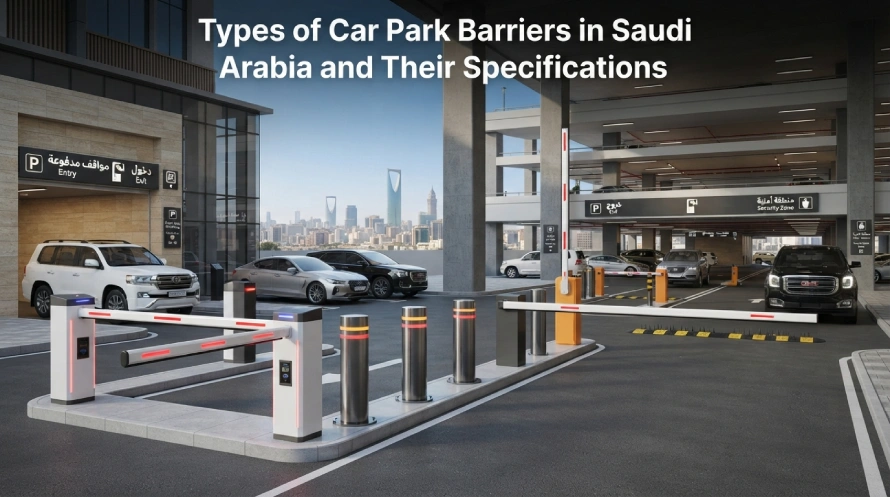
1. Boom Barriers
These are automated barriers with a horizontal arm that moves up and down to control vehicle entry and exit. You can get these barriers with manual control. Boom barriers are commonly used in commercial parking lots, residential complexes, and office buildings to control access.
2. Rising Bollard Barriers
Retractable vertical barriers installed at ground level to prevent unauthorized vehicle access and create safe entry points. They are suitable for restricted parking zones, government buildings, and high-security facilities. Rising bollard barriers are usually made of heavy-grade metal to withstand physical impact without bending or breaking.
3. Sliding Gate Barriers
Barriers that slide horizontally to open or close vehicle access points. These are versatile barriers that are optimal for residential, commercial, as well as industrial sites. In industrial and commercial applications, these gates are attached to a remote locking mechanism. This allows you to provide easy access to authorized vehicles and prevent unauthorized ones.
4. Automatic Barrier Gates
Sensor-operated barriers that automatically control vehicle access using RFID cards, access codes, or ticketing systems. Widely used in shopping malls, airports, hospitals, and multi-level parking facilities. They are usually on the expensive side, but provide services that are worth the price.
5. Manual Parking Barriers
These are the simplest parking barriers that are operated by hand and are used to restrict vehicle movement in areas with low traffic or limited access requirements. Suitable for small residential parking spaces and private premises.
If you are confused about which car park barrier will suit your requirements, Match Industry experts are here for you. Reach out to our customer support staff, and they will connect you to our experts, who will help you choose the right product and also provide you with installation support for comprehensive coverage.
Materials Used to Make Car Park Barriers
Car park barriers in Saudi Arabia encounter harsh climate conditions and are exposed to scorching sun. Thus, material choice for the barriers becomes a critical decision, as most of the car park barriers are installed outdoors. Galvanised steel following ASTM A36 and ASTM A653 is the most commonly used material as it provides superior durability and can easily withstand high-impact collisions.
Plastic and high-density polyethylene are also used to make lightweight temporary car park barriers, as they are easy to move around as per the requirements. If you are going for a more visually aesthetic finish, stainless steel and aluminium are the right materials to go for.
Matco Industry offers a wide range of material choices so that you can choose the right one and receive optimal car parking safety and privacy.
Concluding Note From Matco Industry
Choosing the right car park barriers in Saudi Arabia requires careful consideration of the installation site, traffic volume, security requirements, and environmental conditions. While boom barriers and automatic gates are suitable for controlling vehicle access, rising bollards provide additional security for restricted areas. Similarly, manual barriers and lightweight plastic options are practical choices for temporary parking arrangements. Therefore, understanding the specifications, materials, and functionality of each barrier type helps you make an informed decision.
Material quality is equally important, particularly when barriers are exposed to Saudi Arabia’s extreme temperatures, dust, and outdoor conditions. Matco Industry offers Galvanised steel, stainless steel, and aluminium to ensure durability for permanent installations, while lightweight car park barriers in Saudi Arabia are optimal for temporary applications. Choosing Matco Industry ensures quality products, proper installation, and after-sales support to ensure long-term performance and safety.
FAQs
Boom barriers, rising bollards, sliding gates, automatic barrier gates, and manual parking barriers are some of the most commonly used options across residential, commercial, and industrial sites.
Galvanised steel, stainless steel, and aluminium are suitable for outdoor applications because of their durability and resistance to environmental exposure. The appropriate choice depends on the required strength and maintenance conditions.
Yes, automatic barriers are ideal for commercial properties with frequent vehicle movement. They can integrate with RFID cards, access control systems, sensors, and ticketing systems to manage entry and exit.
Boom barriers use a horizontal arm to control vehicle access, whereas rising bollards are vertical retractable posts installed in the ground. Boom barriers primarily manage traffic flow, while rising bollards offer stronger physical access restrictions.
Consider the installation location, vehicle traffic volume, required security level, barrier material, operating mechanism, weather resistance, maintenance requirements, and available installation space.