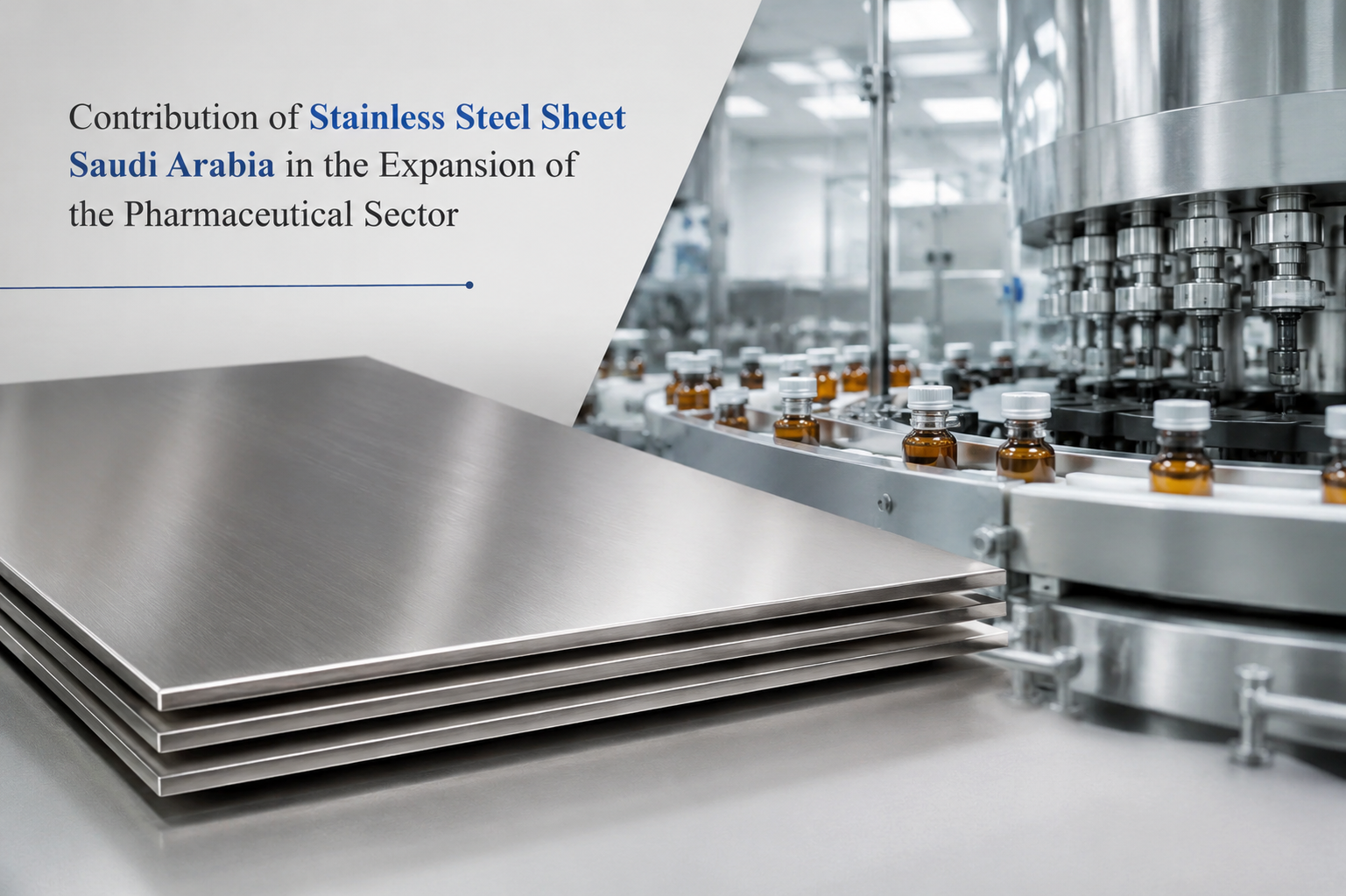
Contribution of Stainless Steel Sheet Saudi Arabia in the Expansion of the Pharmaceutical Sector
Saudi Arabia is quickly emerging as a leader among regional producers and distributors of life sciences and medical products. They have set up the Vision 2030 program for it and are implementing changes to make this vision true. There arises an urgent need for high-quality stainless steel sheet Saudi Arabia construction materials that meet stringent requirements. Because the materials used for machinery and surface finishing are inspected with the same thoroughness as the medication itself. In other markets, it might seem like an ordinary product, but to pharma industries, it becomes a technical item.
The pharmaceutical industry applies a rigorous standard for pipe fittings, as it demands surfaces that are chemically inert. In addition, it is highly resistant to pitting: the formation of microscopic cavities where bacteria can thrive. Manufacturers are challenged to find stainless steel sheet Saudi Arabia in high-quality materials capable of surviving multiple, highly aggressive sterilization treatments.
Moreover, this blog discusses how certain types of stainless steel play an essential part in ensuring pharmaceutical cleanliness. It examines how high-quality material specifications are dictating the future of Saudi Arabia’s health care sector.
Comparing Pharma Grade Alloy (304 vs. 316L)
The selection of the right alloy becomes the critical factor that decides whether a manufacturing plant will remain sterile for years. So, it will not suffer from premature corrosion problems. Although different kinds of stainless steel sheet Saudi Arabia are available, including 304 and 316L grades. It is the latter two that are mostly preferred by the industry. The letter “L” in 316L indicates that this particular material has been manufactured with low carbon.
Given the climate conditions in Saudi Arabia, which entail the presence of humidity and salts in coastal cities where plants are installed. It becomes even more imperative for a material to be strong enough against internal and external corrosive forces. At Matco Industry, we recommend choosing the right alloy grade strategically.
| Feature | Grade 304 (Industrial) | Grade 316L (Pharma-Grade) | Impact on Saudi Pharmaceutical Operations |
|---|---|---|---|
| Chemical Shielding | 18% Chromium, 8% Nickel. | 16% Chromium, 10% Nickel, 2% Molybdenum. | Molybdenum protects against chloride-induced pitting common in saline coastal air. |
| Sanitization Resilience | Suitable for mild detergents and dry storage. | Withstands aggressive acids, alkaline cleaners, and high-pressure steam. | Essential for Clean-in-Place (CIP) systems that require frequent chemical sterilization cycles. |
| Surface Integrity | Standard finish; may develop micro-pores over time. | Ultra-smooth finish with low Roughness Average (Ra) values. | Eliminates microscopic “pits” where bacteria and contaminants hide, ensuring 100% sterile surfaces. |
| Welded Joint Durability | Standard carbon; prone to “weld decay” in humid environments. | Low Carbon content prevents intergranular corrosion after fabrication. | Guarantees that welded lab benches and storage tanks remain rust-free at the seams for decades. |
| Saudi Environment Fit | Best for inland Riyadh and central dry regions. | Highly recommended for Red Sea and Arabian Gulf industrial zones. | Prevents “tea staining” and surface oxidation caused by the intense Saudi heat and humidity. |
| Primary Use Case | External cabinetry, structural framing, and cladding. | Reaction vessels, lab surfaces, and direct medicine contact units. | Maintains the absolute chemical purity required for active pharmaceutical ingredients (APIs). |
Technical Reasons Matco Industry’s Sheets are Vital for Pharma Growth
By providing stainless steels with lower carbon and improved corrosion resistance properties, Matco Industry ensures that facilities in Saudi Arabia can create lab bench tables, chemical cabinets, and wall panels that satisfy international standards of cleanliness. In an industry where machinery needs to withstand decades of continuous operation and heavy cleaning, the technical features of the material used are the key criterion for success.
As one of the top suppliers of stainless steel sheets in Saudi Arabia, we offer materials of the highest quality. That is needed for manufacturing excellence by the following five criteria:
1. Chemical Inertness and Product Purity
The steel sheets from Matco are created so that they do not react with any chemicals. This makes it possible to avoid any chemical reaction with the APIs that are used in medicines. That helps us to maintain absolute purity of the material.
2. Optimized Surface Finishes Low Ra Values)
The company produces steel sheets with a certain level of Roughness Average (Ra) values. With options available for a mirror-like polished surface or a brushed surface. This makes it possible to provide a surface that does not contain any tiny cracks where bacteria can settle.
3. High Thermal Resilience for Sterilization
The process of “Sterilization-in-Place” (SIP) involves the use of hot steam under pressure. Our steel sheets can resist high temperatures and do not get damaged in such conditions.
4. Exceptional Pitting Resistance in Saudi Climates
The high temperature and humidity of locations such as Jeddah and Dammam have the potential to cause metal fatigue. Our high molybdenum content sheets protect against “pitting” and “tea staining” and ensure that your facility is completely protected both inside and outside from rust.
5. Engineering Versatility and Compliance
At Matco Industry, we offer an extensive range of different thicknesses and sizes for your Saudi engineering needs. You can rest assured that you are creating sterile containers, ducts, and even pressure vessels. While being entirely in compliance with ASTM and SFDA standards.
Final Thoughts!
The pharmaceuticals industry is one of the most regulated industries in the world that requires standards to be followed strictly. Therefore, building a compliant facility there requires stainless steel sheet Saudi Arabia, which is more than just a supplier’s work. It requires a partner who understands the quality of the sheets used and how they will directly impact public health. Only then can they build a rigorous material sheet perfect for use in the pharmaceutical industry with compliance needs intact.
To continue contributing positively to the industrial growth of the Kingdom, Matco Industry will continue to provide top-notch grades of stainless steel. These include 316L and 304 that are necessary in modern-day medicine. In industries, the presence of even a single particle is enough to ruin a whole batch of production. We are dedicated to providing our customers with premium-quality steel sheets. Therefore, with the right kind of steel sheets at hand, your healthcare sector will be able to prosper.
FAQ
Grade 316L contains molybdenum and lower carbon compounds in it, which provide exceptional resistance to corrosive sanitizers. Additionally, preventing rust after welding and maintains the long life of steel structures. These quality standards are vital for maintaining the sterile, contaminant-free environments required by global pharmaceutical regulators.
A lower Ra value means a smoother surface. It prevents bacteria and particles from getting trapped in the microscopic grooves, ensuring that cleaning agents can effectively sterilize the entire surface of the equipment.
Yes, Matco Industry delivers technical documents alongside all mill test certificates (MTCs) for its bulk orders for client satisfaction. This way, it guarantees complete traceability and verifies the chemical composition according to the necessary standards set by ASTM.
We are well-stocked with various types and thicknesses of stainless steel along with logistics solutions. In other words, we guarantee timely delivery at the construction site in such cities as Riyadh, Jeddah, and Dammam.
We deliver special shearing and custom cutting services to our customers. Our services include customized cutting of stainless steel sheets, which will assist in faster production of pharmaceutical equipment.