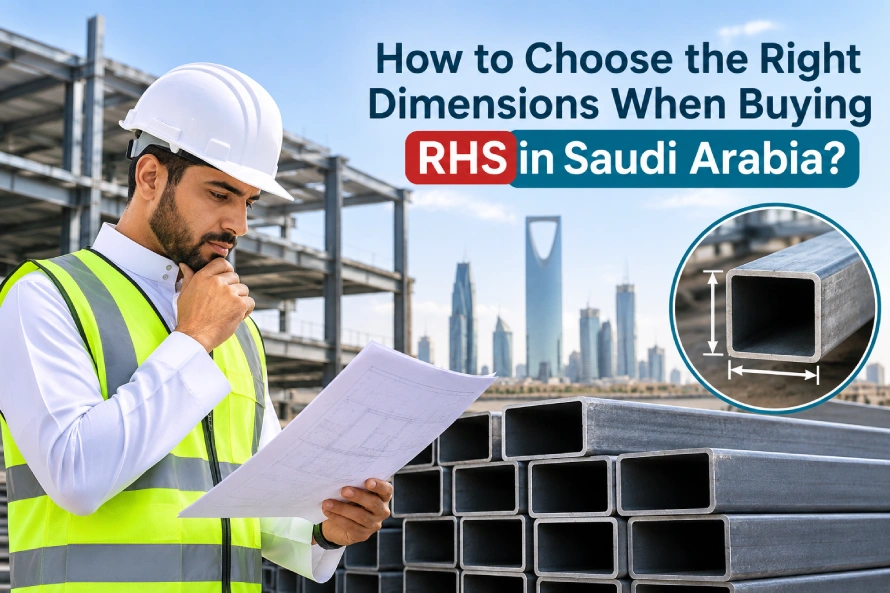
How to Choose the Right Dimensions When Buying RHS in Saudi Arabia?
Choosing the right RHS in Saudi Arabia ensures structural stability, sustainability, durability, and cost efficiency across construction and industrial applications. Whether you are working Don a commercial building, an industrial facility, or an infrastructure project, choosing the right dimensions can significantly affect your structure’s overall performance. With numerous sizes, wall thicknesses, and material technical specifications available, understanding your project requirements in advance is crucial. When sourcing rectangular hollow sections, buyers consider factors including load-bearing capacity, environmental conditions, structural design, fabrication needs, and applicable industry standards. The growing construction and infrastructure sectors demand steel products that deliver consistent quality and dependable performance under challenging operating conditions.
But how do you determine which dimension of an RHS in Saudi Arabia is appropriate for your application? In this comprehensive guide, we will discuss the essential considerations, technical configurations, and practical selection criteria to help you make an informed purchasing decision.
What is RHS in Various Applications?
Rectangular Hollow Section (RHS) is a form of structural steel that has a hollow core with a rectangular cross-section. The strength, lightness, and constant shape of this product make it ideal for use where there is a need for solid structure without excess use of materials. RHS is widely used in building construction, industrial structures, machinery supports, bridges, architectural designs, and manufacturing industries. The flat sides also make it easier to cut, weld, drill, and assemble. When choosing RHS in Saudi Arabia, the application of the product plays a vital role in deciding on the section size, wall thickness, and steel quality.
Key Features of RHS in Different Applications
- High Structural Strength: It ensures reliable resistance to bending and other structural loads when properly selected.
- Uniform Shape: The square shape allows uniform manufacture and easy structural joints.
- Good Weight Management: It ensures a good strength-to-weight ratio for engineering uses.
- Easy Fabrication: Can be cut, welded, drilled, and machined based on the requirements of the particular project.
Technical Configurations of Rectangular Hollow Section
| Technical parameter | Common configurations or considerations |
|---|---|
| Cross-sectional shape | Rectangular Hollow Section |
| Section dimensions | Width x Height in mm as per requirement |
| Wall thickness | Normally 1.5mm – 12mm or as required |
| Standard lengths | 6m, 9m, 12 m, or other custom sizes |
| Steel grades | Grades S235, S275, S355 and ASTM A500 as per requirement |
| Manufacturing process | Either hot-finished or cold-formed |
| Surface finish | As black steel, painted, or galvanized |
| Manufacturing standards | EN 10219, EN 10210, ASTM A500, etc. |
| Applications | Structures and frameworks |
Things to Consider When Choosing the Right Dimensions When Buying RHS
Here, we have mentioned some significant things that you must consider when choosing the right dimensions when buying RHS in Saudi Arabia:
1. Identify Where the RHS Will Be Used
Firstly, consider the intended use of the RHS. A section designed for a light installation may lack the necessary capacity used for heavy-duty construction. Determine if the section is going to be used in columns, beams, support frames, equipment structures, or fabrication. Knowing the section purpose helps determine the right size and avoid wasteful utilization of material. In addition, it allows engineers and procurement officers to set realistic performance criteria before requesting quotes from suppliers.
2. Assess Load-Bearing Capacity Needed
This criterion largely determines the size of RHS in Saudi Arabia to choose. One needs to take into consideration the dead loads, live loads, and wind loads that the structure is going to bear over the course of its operation. The larger the section and the thicker the wall, the better the capacity. You should always keep in mind the orientation of the section, unsupported length, connections, and the likelihood of buckling. Consult a professional structural engineer regarding the capacity needed.
3. Choose the Suitable Wall Thickness
Thicker walls mean stronger, stiffer, heavier, and more difficult-to-manufacture RHS. Thin walls might be suitable where there is not much stress on the structure. However, thicker walls might become necessary where more stress and higher loads exist. Choosing thick walls without assessing the need for them might unnecessarily increase cost. While purchasing RHS in Saudi Arabia, thickness should be considered against engineering calculations, welding needs, and service conditions.
4. Evaluate Environmental and Corrosive Properties
Environmental suitability is one of the factors that should be considered when making the purchase since Saudi Arabia has different climatic environments. Temperature, high humidity in coastal areas, dust, and a corrosive environment may affect the performance of the steel. You should evaluate the need to galvanise, paint, or apply another type of protection to the RHS in Saudi Arabia based on the exposure category, maintenance programme, and the project site. Selection of the right type of material and protection will increase the life span of the RHS and its durability.
5. Confirm the Material Grade and the Standard of Manufacture
It should be noted that not all RHSs have the same mechanical and manufacturing properties. Different steel grades provide different yields, strengths, and weldability of the product. Check whether the proposed material complies with the engineering specification and the manufacturing standards such as EN 10219, EN 10210, or ASTM A500, wherever it is appropriate. Mill test certificates and dimensions should be requested where necessary.
6. Supplier’s Capability to Deliver and Availability of Product
It is not just about choosing the right dimensions that will make your purchase successful. It is necessary to verify if the supplier will be able to deliver the necessary sizes, grades, thicknesses, and lengths according to the project schedule. You have to look into such factors as documentation of products, quality control, logistics, and availability of technical assistance. In evaluating different suppliers of RHS in Saudi Arabia, take into consideration the total package and not just the price quote.
It’s Time to Wrap Things Up!
The choice of appropriate rectangular hollow sections is essential to achieve structural reliability, effective material usage, and efficient project performance. Whether it comes to understanding the load requirements or evaluating the material grade, dimension, or environmental conditions, every decision made regarding this matter is integral to the success of the steel structure. Adequate planning and correct technical evaluation can protect you from extra costs and guarantee the purchase of the desired material according to your engineering requirements.
For those companies that need reliable RHS in Saudi Arabia, collaborating with a trustworthy steel supplier is going to be much easier. Matco Industry knows how important it is to acquire steel products that meet your project requirements and all industry standards. The emphasis that we place on product quality, dependable supply chain, and client-oriented solutions makes it easier for our clients to procure steel products. No matter whether you need steel products for construction, industrial purposes, or any other application, contact us right now. Learn more about our steel products and talk to us about your RHS needs.
Frequently Asked Questions
There is no standard RHS size used everywhere. There are several RHS sizes such as 50 × 50 mm, 100 × 50 mm, and 100 × 100 mm.
These factors include:
- Expected load on the structure.
- Structural needs related to bending.
- Length of the unsupported area and buckling of the RHS.
- Requirement of welding, drilling, etc.
- Corrosion protection in environmental exposure conditions.
Yes. RHS may be used in the open environment as long as the material grade and protection system are adequate. Hot-dip galvanising or other types of protective painting systems could be used.
Rectangular Hollow Section has a rectangular shape, while Square Hollow Section (SHS) has a square shape.
Popular standards that may be used include EN 10219, which applies to cold-formed welded structural hollow sections. EN 10210 applies to hot-finished structural hollow sections, and ASTM A500 applies to cold-formed welded and seamless carbon steel structural tubing.